How does a Battery Energy Storage System (BESS) reduce a commercial facility's energy costs?
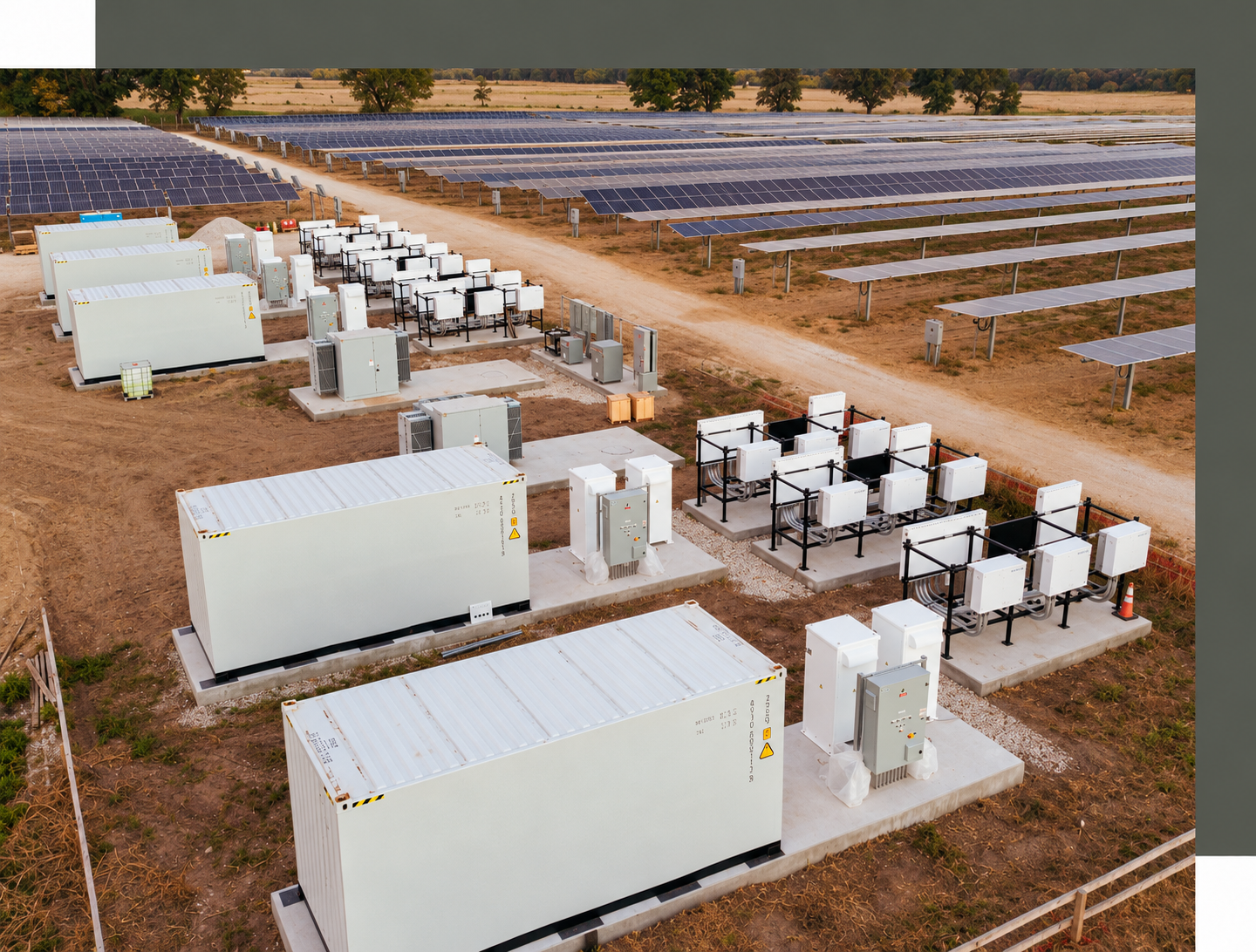
Commercial and industrial facilities are billed not just for the total electricity they consume, but for their peak demand, the highest 15-to-30-minute period of electricity draw in a given billing cycle. These demand charges can be enormous, especially for facilities with heavy equipment startups, compressors, or production spikes. A BESS charges during low-cost overnight hours and discharges during those peak periods, flattening your demand curve and dramatically reducing the charges. Beyond demand reduction, BESS also enables facilities to buy electricity when utility rates are lowest and avoid purchasing it when rates are highest, a strategy called energy arbitrage. For facilities with on-site solar, a battery stores excess midday generation instead of exporting it at low value, then deploys it during expensive evening hours, improving the ROI of both the solar and battery together.
What is the ROI and payback period for a commercial battery storage system?
The exact ROI depends on your facility's demand charge structure, utility rates, energy consumption patterns, and whether you participate in frequency regulation revenue programs through a platform like Intelligent Generation's POWR:Suite. Facilities in deregulated electricity markets (including Michigan, Illinois, Ohio, Indiana, Pennsylvania, and other PJM/MISO states) have access to the full range of revenue opportunities, demand charge reduction, energy arbitrage, frequency regulation revenues, and capacity market participation, which compound the financial return significantly. The 30% ITC, combined with accelerated MACRS depreciation, can reduce effective net project cost by 50 to 60% in the first year. Harvest Solar and IG provide a no-cost POWR:Plan project assessment with detailed cash flow projections before you commit to anything.
Can a commercial battery storage system actually earn revenue, not just save money?
This is the least understood, and most financially significant, aspect of commercial BESS for many facility operators. The electric grid requires constant, real-time balancing of supply and demand. Grid operators pay commercial battery owners to provide that balancing capability, charging and discharging rapidly in response to grid signals, through frequency regulation programs. Intelligent Generation's POWR:Ops platform handles the automated bidding, clearing, and dispatch for this process, deploying your battery toward its most valuable use at any given moment without any manual intervention from your team. Facilities within the PJM and MISO regional transmission organizations, which cover Michigan, Illinois, Indiana, Ohio, and several other Midwest and Mid-Atlantic states, are eligible to participate. In some cases, frequency regulation revenues alone can meaningfully accelerate the project payback timeline.